Your brain: a control center that works through networks
The brain helps coordinate sensation, movement, thought, memory, language, and many automatic functions. It works with the spinal cord, nerves, and the rest of the body. It is a living network, not a single switch: several regions work together for most activities.
When you lift a cup, your brain uses information about what you see and feel, plans movement, and helps coordinate your hand. You do not consciously instruct every muscle or every breath. Some responses, including certain reflexes, can be organized through the spinal cord.
See the brain and explore its parts
| Part | What it helps do |
|---|---|
| Frontal lobe | Planning, problem-solving, and complex thinking. |
| Parietal lobe | Working with sensory information and aspects of language. |
| Temporal lobe | Processing sounds and supporting language. |
| Occipital lobe | Processing visual information. |
| Cerebellum | Balance and coordination. |
| Brain stem | Basic functions, including breathing and heart-rate regulation. |
| Cerebral cortex | The folded outer layer involved in many sensory, thinking, and movement processes. |
How fast can we hear, grasp meaning, and answer?
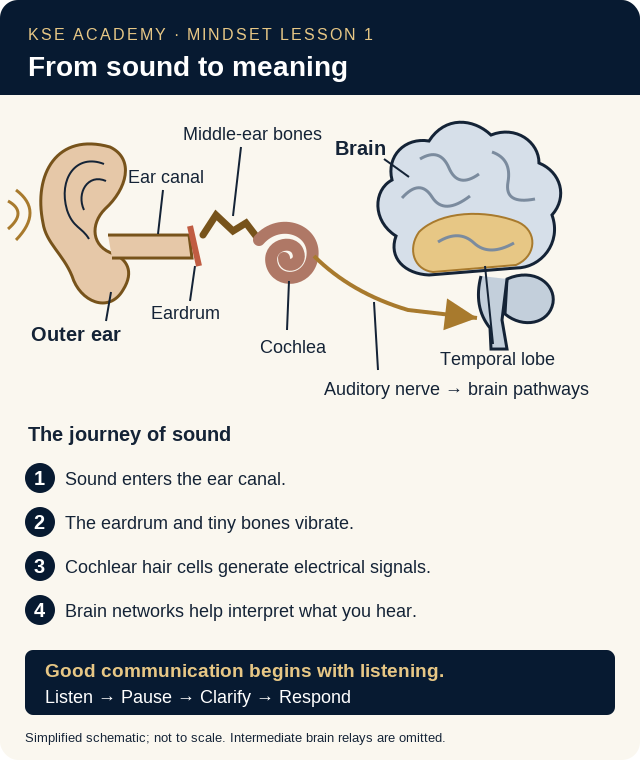
Sound waves travel through the ear canal and vibrate the eardrum. Three small middle-ear bones transmit and amplify those vibrations into the fluid-filled cochlea. Sensory hair cells turn this movement into electrical signals carried by the auditory nerve. These inner-ear hair cells are different from the hairs on your arm. Follow NIH’s explanation of how we hear. Brain networks work with those signals, recognize speech patterns, connect words with context, and help prepare a response. Hearing a sound, grasping a sentence’s meaning, and choosing a useful answer are related but different tasks.
In one speech-processing study, an early word-sensitive brain response began around 60 milliseconds after sound onset, while an effect of meaning-related context began around 217 milliseconds. A millisecond is one thousandth of a second. These are measurements from a particular experiment, not a universal time for fully comprehending someone or answering wisely.
There is no single reliable “words per minute” capacity that tells us how quickly everyone can hear, grasp meaning, and answer. Familiarity, attention, noise, complexity, and individual differences matter. A fast response is not automatically an accurate response.
A good communicator must first be a good what?
A listener. Patience gives the other person room to finish and gives you room to check what you heard. If you are preparing an argument while someone speaks, you may miss the point you are trying to answer.
Practice this sequence: listen, pause, summarize, clarify, then respond. Try, “What I hear you saying is… Have I got that right?” If you missed something, ask for repetition. Hearing differences or a need for more processing time do not make someone a poor communicator.
“He that answereth a matter before he heareth it, it is folly and shame unto him.”
In the KSE WAY, listening is an expression of respect and stewardship of thought. We can speak, but meaningful engagement asks us to make room for another voice.
Practice before moving on
Let a partner speak for one minute without interruption. Summarize their main idea before offering your opinion. Ask them what you captured and what you missed. What did patience help you notice?
Carry your learning forward
Your brain receives information, but how do you become aware of an experience and decide what it means? Next, connect consciousness, conscience, and the perspective you bring to life.
Continue to lesson 2